Table of Contents
- Why Rope Access for Port Facility Maintenance Makes Sense
- Rope Access Versus Scaffolding: What Port Managers Need to Know
- IRATA-Certified Rope Access Technicians: The Backbone of Safe Port Work
- Frequently Asked Questions
Last Updated: October 19, 2026
Why Rope Access for Port Facility Maintenance Makes Sense
Port facility maintenance is the planned inspection, cleaning, repair and testing of the structures that keep a port working: cranes, quay walls, mooring bollards, silos, transit sheds, pipework and ship holds. Rope access lets trained technicians reach those assets on a rope system instead of a scaffold. Ports cannot afford to shut a berth for a week to erect towers.
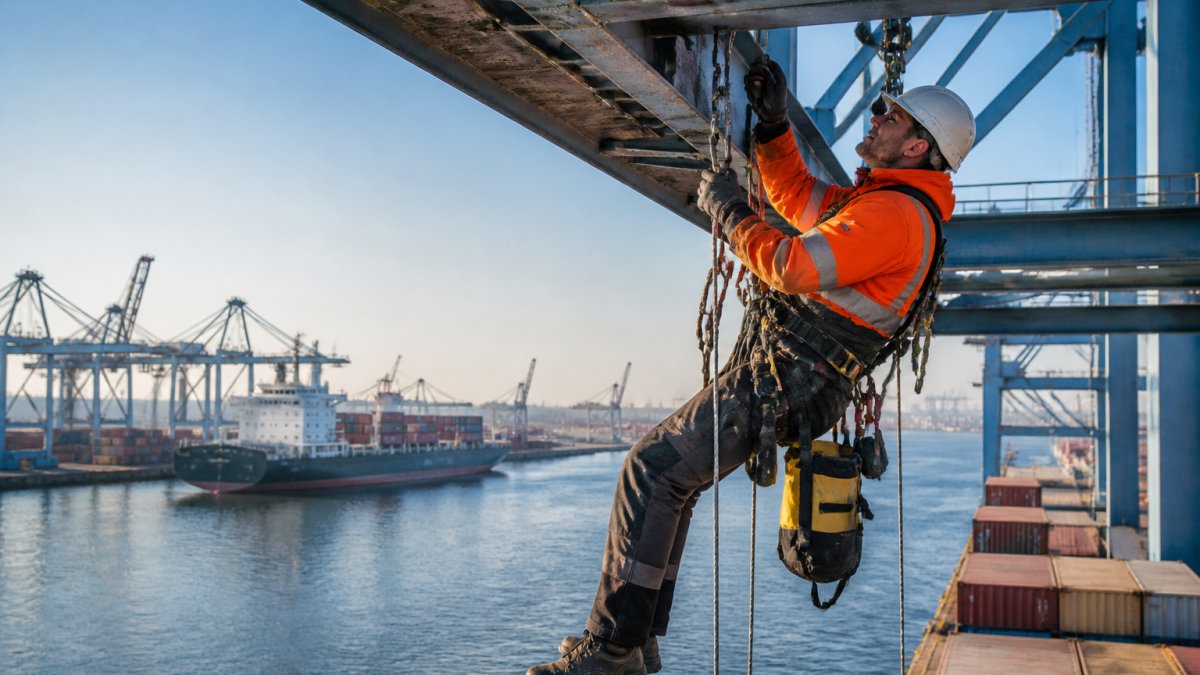
A port is a live industrial site where every hour of downtime costs money. Rope access rigs from an anchor point above the work and puts a two-person team exactly where the defect is, no scaffold footprint on the quay, no aerial platform blocking the crane rail.
The main reason ports choose rope access is not the day rate. It is the fact that the asset stays in service while the work happens.
Rope Access Versus Scaffolding: What Port Managers Need to Know
Rope access usually beats scaffolding for inspection, testing, cleaning and small repairs on tall or awkward port structures. It loses on large-area heavy works, where a platform still wins.
| Factor | Rope Access | Scaffolding |
|---|---|---|
| Setup time | Hours | Days to weeks |
| Quay space used | Minimal | Large footprint |
| Best for | Inspection, cleaning, minor repair | Heavy works, long campaigns |
| Cost pattern | Lower for short jobs | High fixed cost |
| Berth disruption | Low | Often significant |
The trade-off is real. A rope access team carries limited tools and materials. If you need to replace a full crane jib section, bring in the scaffold or a crane. For everything short and awkward, the rope wins.
A common mistake is comparing headline day rates only. Add scaffold erect and dismantle, lost berth time and security escorts, and the picture changes fast.
IRATA-Certified Rope Access Technicians: The Backbone of Safe Port Work
IRATA-certified rope access technicians make this method safe. IRATA, the Industrial Rope Access Trade Association, grades technicians from Level 1 to Level 3; a Level 3 supervisor runs the job and signs off the rigging.
Ports add hazards a plain building façade does not have: moving cranes, tidal water below, salt spray, wind funnelling between sheds and vessel movements alongside. The team needs more than a certificate, a site-specific rescue plan, permits and coordination with the harbour master.
Skipping the rescue plan is the mistake that ends contracts. If a technician is suspended and unresponsive, the clock is short. A written, rehearsed rescue procedure must be in place before anyone leaves the ground.
Under the Work at Height Regulations 2005, you must avoid work at height where you can, and use the right access method where you cannot. Rope access fits that duty when it is planned properly. The Health and Safety Executive publishes guidance on selecting and managing rope access contractors.
Frequently Asked Questions
How is rope access used for port facility maintenance?
Rope access is used for inspection, testing, cleaning, and repairs on port structures that are difficult to reach with scaffolding or aerial platforms. Technicians access high-level areas such as crane booms, silos, ship holds, and façades using rope systems and rigging. IRATA-certified technicians can carry out non-destructive testing, surface cleaning, and minor repairs without the setup time and disruption of traditional access methods, making it a cost-effective solution for port facility maintenance.
Is rope access safer than scaffolding for maintenance work at height?
Rope access safety at height depends on proper training, equipment, and planning. When carried out by IRATA-certified technicians under a robust safe system of work, rope access can be safer than scaffolding because it reduces the number of people at height and minimises the need for large teams. It also avoids the risks associated with erecting and dismantling scaffolding. However, both methods require thorough risk assessments, anchor point verification, and rescue plans to ensure safe access.
What qualifications should rope access technicians have?
Rope access technicians should hold current IRATA certification at the appropriate level for the task. IRATA-certified rope access technicians are trained in rope systems, rigging, rescue, and working at height. They should also have relevant industry experience and familiarity with port environments. Additional qualifications such as NEBOSH or confined space training may be required for specific tasks. Always verify certification and insurance before appointing a contractor for port facility maintenance.
Ports run on uptime, and every access method has a cost beyond the invoice. Rope access keeps berths working while inspection, testing and cleaning get done. SLRAS provides IRATA-certified technicians, full site surveys, lift plans and RAMS, and 24/7 emergency response, all backed by over 20 years of hands-on experience. Get a free quote and see how we would plan your next port campaign.